PVD coatings
| PVD Coatings | Colour | Hardness | Elastic modulus E | Oxidation temperature | Coefficient of friction on 100Cr6 | Deposition temperature | Typical thickness |
|---|---|---|---|---|---|---|---|
| TiN | Yellow gold | 2800 ± 50 HV | 450 ± 10 GPa | 600°C | 0,40 | 300°C-480°C | 2-7 μm |
| TiCN | Grey blue | 3200 ± 50 HV | 310 ± 10 GPa | 420°C | 0,30 | 450°C | 1-3 μm |
| AlTiN Nano | Dark purple | 3200 ± 50 HV | 340 ± 10 GPa | 900°C | 0,40 | 300°C-480°C | 2-3 μm |
| Silicut | Purple orange | 4200 ± 50 HV | 490 ± 10 GPa | >1100°C | 0,40 | 480°C | 2-3 μm |
| SiliCrome | Purple orange | 4000 ± 50 HV | 560 ± 10 GPa | >1100°C | 0,35 | 480°C | 2-4 μm |
| HALCROME | Grey blue | 4000 ± 50 HV | 550 ± 10 GPa | >1100°C | 0,30 | 480°C | 1-3 μm |
| GearCut | Grey blue | 3350 ± 50 HV | 450 ± 10 GPa | 1000°C | 0,30 | 480°C | 3-5 μm |
| Alticrome | Grey | 4300 ± 50 HV | 390 ± 10 GPa | 1100°C | 0,35 | 480°C | 3-6 μm |
| NICOAT | Dark grey | 3500 ± 50 | 400 ± 10 GPa | 1100°C | 0,35 | 480°C | 4-6 μm |
| AlCro-X | Dark grey | 3200 HV ± 50 | 400 ± 10 GPa | 1100°C | 0,30 | 480°C | 3-5 μm |
| CrN | Grey | 2000 ± 50 HV | 400 ± 10 GPa | 700°C | 0,30 | 250°C - 350°C | 2-7 μm |
| Cromvic | Grey black | 2000 ± 50 HV | 320 ± 10 GPa | 400°C | 0,15 | 250°C | 1-2 μm |
| HELIOS | Light yellow | 2700 ± 50 HV | 380 ± 10 GPa | >1800°C | 0,30 | 250°C - 600°C | 1-2 μm |
Thin-film coatings with high-vacuum PVD technology

miniToolsCoating s.r.l. was founded in 2001 with the aim to offer high-quality PVD coatings for application on dies, mechanical parts and chip removal tools.
Our cathodic arc PVD technology allows the production of coatings with excellent technical and functional features, increasing the performance of the treated components and allowing a higher efficiency of the manufacturing processes.
They are the result of a close technical collaboration with the manufacturers of the equipment we use, the experience acquired by cooperating with our customers every day and the professionalism of our staff.
Our PVD coatings generally have a thickness between 1 and 4 microns and perfectly replicate the shape of the underlying surfaces. Sharp edges remain virtually unaltered and the same is true for the roughness of the coated surfaces.
Our PVD coatings have special structures and compositions which provide the treated surfaces with application-specific properties.
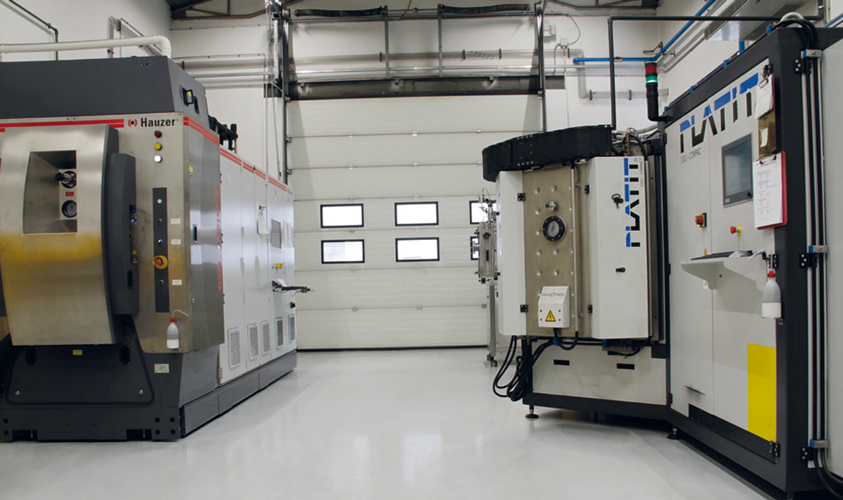

PVD technology allows to create ceramic composites that are deposited on the treated parts and replicate exactly the morphology of their surfaces. Layer thickness is typically a few microns.
The different ceramic composites are created in special plants, in particular conditions in terms of vacuum, temperature and potential differences, starting from metallic and gaseous elements that are ionized and recombined in a plasma, the fourth state of matter! Process parameters are many and they must be very accurately controlled to ensure the quality and repeatability of the coatings.
Coatings can have different structures, for example they can be monolayer or multilayer. Moreover, it is possible to produce sequences of different layers, each with a thickness that can be measured in nanometres. In this case, they are called nanolayers.


This coating with a nanocomposite structure is made by incorporating Titanium and Aluminium nanocrystals in a Silicon Nitride matrix. This works as a strong interface and provides the obtained layer with the typical structure of composite materials.
Hardness, friction reduction, resistance to the different wear and chemical inertness mechanisms are the main properties of our coatings.
Their application allows to reduce production costs and increase quality over time. Our coatings increase performance, reduce machine downtime and extend the service life of tools, dies and mechanical parts of various kinds.
Our PVD coatings are made at temperatures between 250 and 500 °C, therefore the substrates to be coated must undergo thermal treatments such as hardening and drawing or stress relieving at a temperature higher than that at which the coating is applied. In any case, it is possible to produce special coatings at lower temperatures.
The parts to be coated must be free from foreign elements such as screw caps or other types of closures and must not be contaminated by paint, glue, loctite, thread lockers, protective oils or long life grease.
Do not use tape or markers on the areas to be coated.
If the parts are braze welded, the alloy must resist to a temperature of at least 600 °C and be free from cadmium.
The areas to be coated must be free from burrs, grinding burns, micro-cracks or residual stresses, surface oxides, burnishing, passivation treatments, electropolishing.
Maximum size for coating
 We can coat parts that occupy at maximum the space of a cylinder Ø 600 mm x H 700 mm, weighing a maximum of 300 Kg.